
Asylums and the history of mental illness has fascinated me for as long as I can remember. Both of my parents worked at the state hospital in North Dakota until we moved to Alaska in 2001. I got my bachelor’s degree in psychology in 2017 and have been working in the field since; including an inpatient mental health facility, ages ranging from 4 to 76.
Two or three weeks ago I started looking at asylum and state hospital cemeteries on find a grave with no real goal. I am documenting age of death, race, cause of death, and how long their stay at the hospital was, in addition to a few more details. Not sure what my end goal is yet…
As I was working through the Geiger Avenue Cemetery (AKA Confederate Home Cemetery, South Carolina Hospital Cemetery, and the White Asylum Cemetery) in Columbia, South Carolina, I came across several death records for individuals whose cause of death was “conflagration” and upon further inspection, they had been burned to death. Down the rabbit hole I went.

The South Carolina Lunatic Asylum was one of the first of it’s kind in the mid 1800s, second to Virginia’s Eastern State Hospital.

The South Carolina Confederate Soldiers’ Home was previously located in front of the cemetery on the corner of Confederate Avenue and Bull Street (eventually the hospital would be nicknamed the “Bull Street Asylum”). The Home opened in 1909 and was built on land owned by the State Hospital. It was closed in 1958.

The asylum grew significantly in the early 1900s, adding a second campus for African-Americans that would ultimately be used as a geriatric care facility. The hospital had both men’s and women’s dining halls, a kitchen, patient rooms, several sun rooms, nurse’s stations, and many bathrooms, some equipped with showers or a bath tub.
Carolina Tony on YouTube got permission and was given a tour of the hospital about 4 years ago. It’s an excellent video!
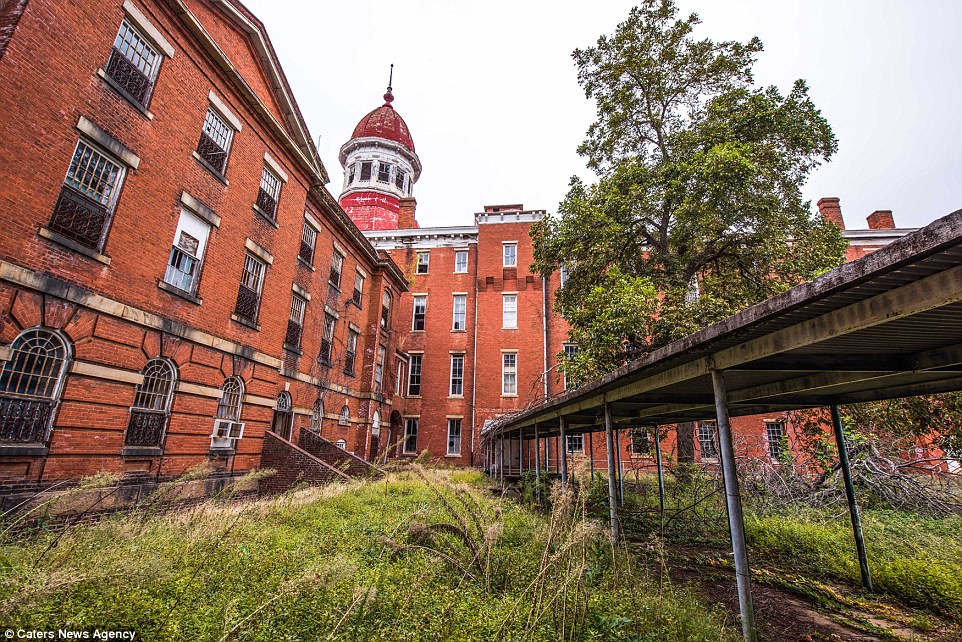
According to Find a Grave, there are 1,029 memorials for people buried at the Geiger Avenue Cemetery and as of November 13, 2013, all of the grave markers with names have been photographed for the website.
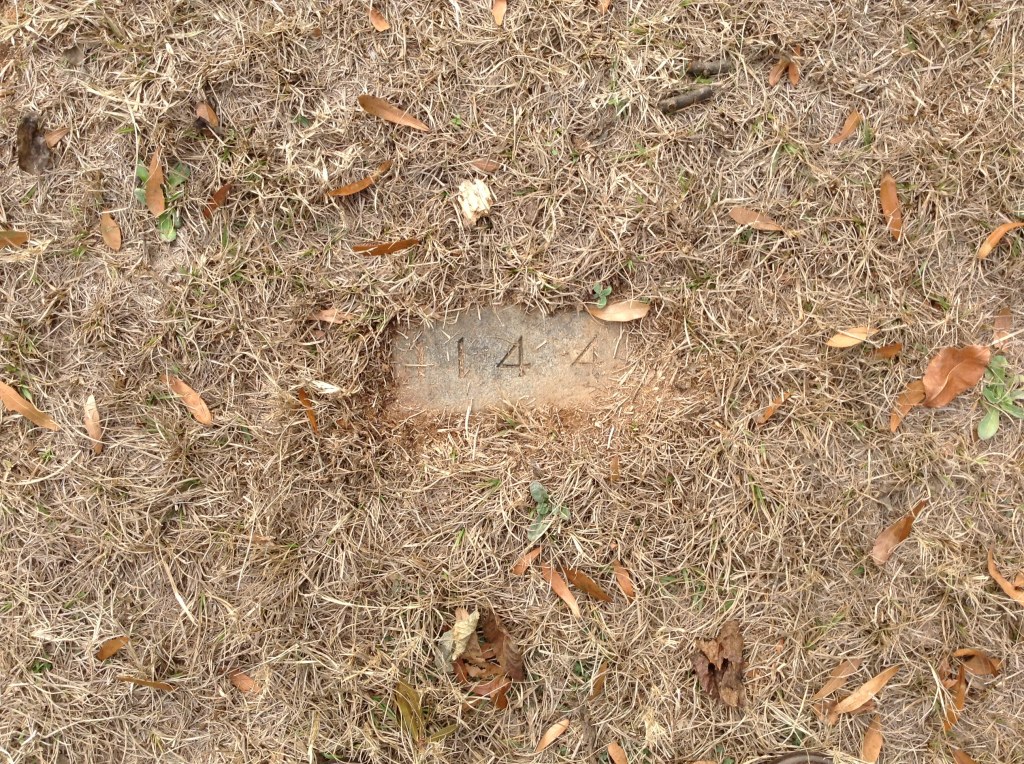
Most of the graves for the State Hospital patients are only marked with plot numbers.
I went through all of the memorials for the Geiger Avenue Cemetery and took data from the individuals that had death certificates. I was mostly looking for any mental health diagnoses, tuberculosis, pellagra, and keeping an eye out for anything interesting or strange.
I had finally got into a groove while entering the data into my spreadsheet until I got to Thomas Wilson Baker (1900-1918), who died tragically young. This was already unusual because most of the people coming before him died in their 60s-70s; he was the first young one I came across. I clicked on his name and was blinded by:

Thomas was one of seventeen men, ages ranging from 12 – 72, who died during the fire that took place in May 1918. A newspaper article published in The State, May 30th, 1918, a day after the fire, states:
SEVENTEEN DIE IN BIG HOSPITAL FIRE
PATIENTS STAMPEDE AND SOME OF RESCUED RUN BACK INTO BURNING STRUCTURE
NO ONE BLAMED FOR TRAGEDY
No theory of Origin of fire except possible defective wiring – two badly burned. Seventeen persons were burned to death when the eleventh was, a single-story wooden structure, at the State Hospital for the Insane, was destroyed by fire at 3 o’clock. Two other patients are in a precarious condition. Fifteen of the patients were burned to death within the four walls. Two died later in the day from burns. The ward was occupied by 45 patients. An inquest was held by Coroner Scott, when a thorough investigation as to the possible cause of the fire was made. From the testimony adduced, no theory was advanced as to the origin of the fire except possibly from defective insulation of the electric wiring. It was developed that all night employees were at their respective posts and that no delinquency of duty was attached to any one connected with the institution. The tragedy was regarded as wholly unavoidable and no blame could be place one anyone.
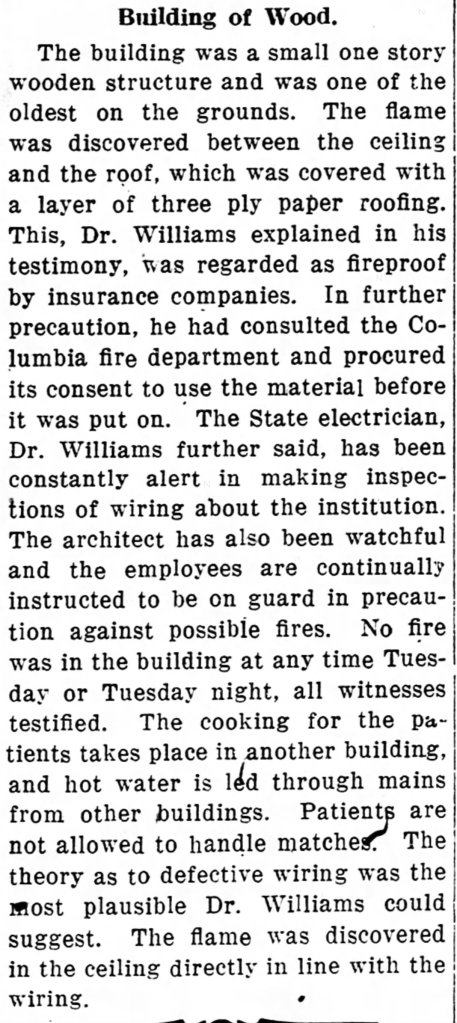
One that was badly burned eventually succumbed to his injuries.
“Patients stampede and some of rescued run back into burning structure” created a pretty graphic and intense image in my mind. I will spare the gory details. After the initial image made it’s way out of my brain, I started to think about some of the people who had made it out but ran back in. Why? Mental illness? Were they intellectually disabled in some way? Was so much chaos happening at the time that they thought the building was somehow a safe place? Were the older patients immobile and abandoned? Did some rush back in to try to help others? I would have been interested to know what originally brought these men to the hospital.
So many questions that we will never know the answer to and these 19 souls will eventually be lost in time.

In 2018, 100 years after the first fire, the Babcock Building was once again aflame, this time making the entire building unsafe for patients. The hospital as a whole is no longer operational and it was last reported that the site, with some of the original buildings, would be turned into apartments.
 Deep Roots Family Tree Blog
Leave a comment