… with Lars and Marie Gullickson
found and passed down by: Aunt Ethel Oxtoby
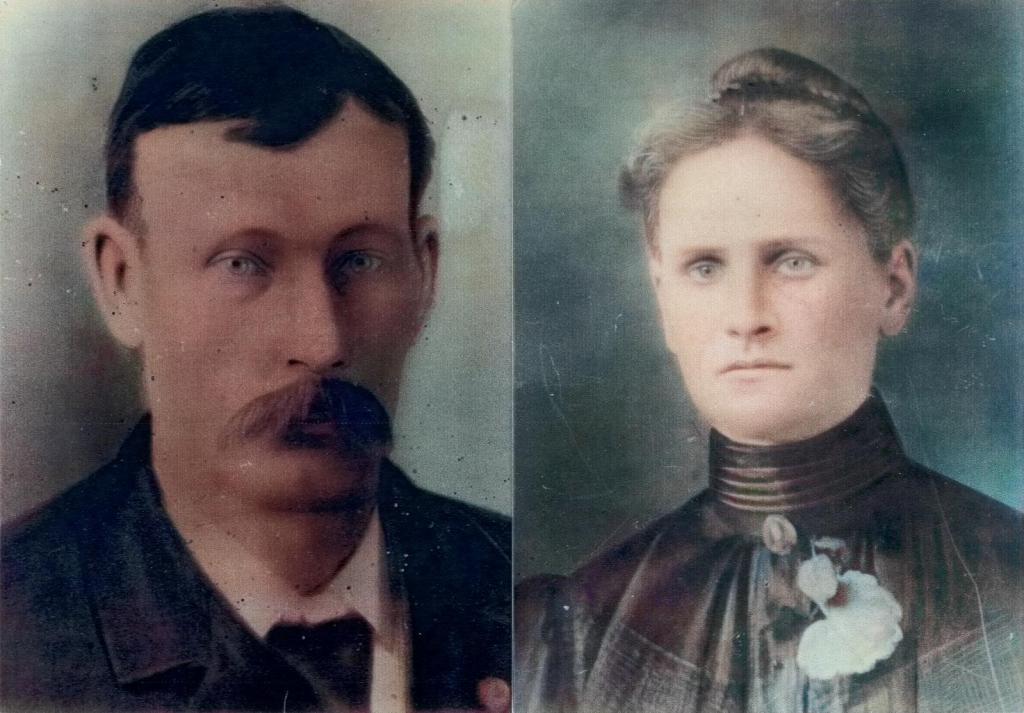
July 9th, 1885, at the age of sixteen, Marie was married to Lars Gullickson, a neighbor boy whose father had a claim near that of Christ Oxhovd. The ceremony was held at a country church near Christine and was performed by Pastor Wisness. Lars had taken a claim that year, two miles west of Ransom City in Ransom County and here the youthful married folks came shortly after the wedding to build a home on their own land.
This was a sod shanty much like the one Marie had helped her father to build. It was 10×14 in size and had a floor, walls and a ceiling of lumber hauled out from Milnor. The walls were made with the stuffing on the outside leaving a smooth board interior. Sods were turned with a play and cut into two foot lengths. Tese were built up around the walls of the board interior and packed close. Sods were also used to cover the roof which was “A” shaped. This shanty when finished made a very neat, comfortable home.
Lars was handy with rolls and made the complete furnishings for the home from lumber. He made four board chairs, a bed, and draw-bed which slipped under the bedstead in a collapsible fashion. He also made a cupboard, table, cradle, and a coffee grinder. The coffee grinder was made in a box and was about 14 inches log, four inches wide, and two inches deep. Lars made a roller for it, having handles and resembling a short rolling pin. This fitted close inside the box. Coffee or a substitute was placed in the box and crushed with the roller. Marie often crushed parched corn or bran for coffee in the homemade coffee mill when resources were low or the supply of coffee had run out.

She also made candles of tallow from beef Lars butchered. Marie borrowed her mother’s metal candle mold which had holes in which the wicking was suspended, hot tallow being poured into the mold around the wicks. When the tallow hardened the mold was released and the finished candles removed. The mold held a dozen candles. Marie also made candles without the mold by dipping a wick in the warm tallow and removing it, permitting the tallow which stuck to the wick to harden. Dipping was continued until the candle became a satisfactory size. At other times when candles and kerosene was not available, Marie used a rag or cloth as a wick in a can or a pail of tallow as a means of illumination. This implement was called a “scutt” and could also be used in cooking.

Marie and Lars built a barn of stone and sods, hauling logs for rafters from Skunk Lake (Tewaukon) with their team of mules and a lumber wagon. They dug a surface or slough well, six or eight feet deep and curbed it with boards, rope and pail serving as a pump.
Marie used a small pioneer stove with an oven and burned a varied lot of fuel in it. She used cow chips picked up near the shanty, and a great amount of hay and straw rolled up into twists. On rare occasions she had coal to burn and firewood that was obtained at Lake Tewaukon, about 10 milles away.
Lars dug a callar under the shanty and here Marie kept her cream, milk, and butter in the summer.
She bought ginghams, denim and outing flannels at the general store of Randolph Holding at Ransom City or store of John Dyste at Rutland.
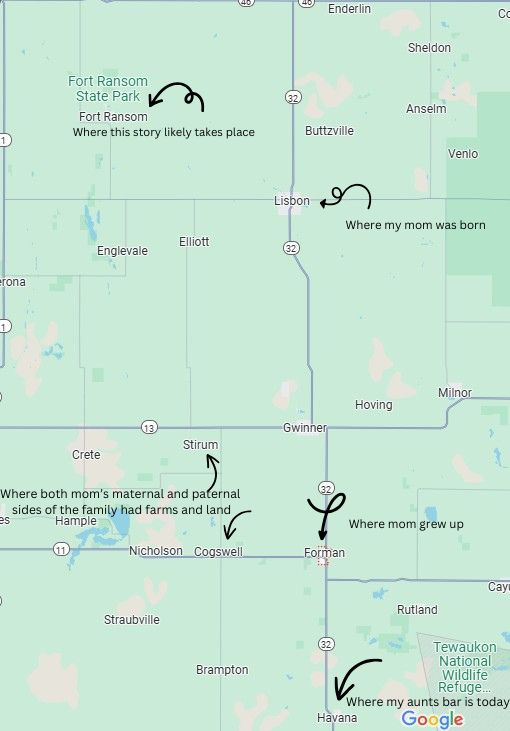
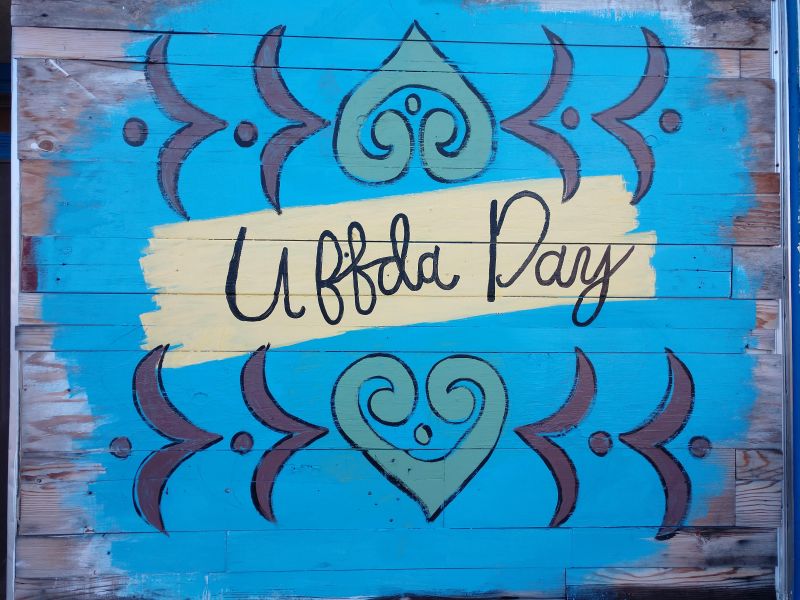
*Fun fact: The grocery store in Forman, North Dakota, where my mother grew up, was owned by the Dyste family and my grandma worked there for quite some time. My cousin went to school with the Dyste kids. Their store and my grandparents’ house shared an alley. Today, Rutland is about a 13 minute drive from Forman and is home to “Uffda Day”.
In the fall, Lars and her would go to Lake Tewaukon to pick plums and berries and became acquainted with John Lange, a half breed Indian and his Indian wife. They often called at the cabin of these on the western shore of the lake. Marie was quite interested in the little Indian woman as she seemed to be about the same age as Marie and she had a tiny dark papoose. She also showed Marie how to cook and preserve wild fruit growing there. The two young wives enjoyed visiting together even if each was somewhat unfamiliar with the others language. Lars enjoyed the good fishing there and pulled many pickerel and bull-heads from the lake.
The nearest neighbors of Lars and Marie at Ransom were the Bostrum, Faust, and Flados families, also Julius Hetland and Alf Johnsons. In 1890, Lars turned his claim over to Randolph Holding and accompanying his father Albert Gullickson moved to a point called Viking about twenty miles from Minnewaukin in Benson County. Here, Lars and his father filed on new claims. Lars pre-emption becoming a gre years later the town site of Maddock, ND. Lars and his father had about sixty head of cattle together. These they drove overland from Ransom to Viking taking most of a week in making the trip. Marie and her two children made the trip by train. A frame house had been partly built by Lars before her arrival. It looked like better country then where the first claim had been at Ransom and thus hopes were high. There was no blacksmith nearer than Oberon or Minnewaukan so Lars built a shop on his claim and began work at the blacksmith trade. His business grew to such a proportion that he hired two helpers and all of them were busy. Viking was two miles south of Lar’s shop and consisting of one general store. Mail was also delivered there.
On the 5th of March 1891, supplies at the Gullickson home were getting low. It had been a hard winter and the customary heavy supplies laid up against the winter season had swindled earlier than expected. The weather was quiet and thawing with a heavy mist falling. It seemed like a good day to make a long trip. They needed coal and would have to go to Minnewaukan or Oberon for it. These towns were each about 20 miles distant but the route to Oberon presented the lesser difficulty in winter because Minnewaukan lay in the Coulee country and there would be deeper snow drifts in that direction. Lars borrowed a sled and box from a neighbor and started out. Part way to Oberson, a blizzard caught him. He went on to town, obtaining the supplies and coal, and began the return trip. The storm increased with nightfall and Lars was hopefully lost. His load floundered in a huge drift and turned over. Lars tried to find the supplies and get the load straightened out. It was an impossible task in such a smother and darkness. He got the team untangled and went on leaving the load and following his horses hoping they might be able to find their way home. He was completely exhausted and was permitting the team to drag him along. He knew the family at home was in dire need of the supplies in the snow bank but he was helpless. He floundered on and suddenly one of the horses shied and stopped. Lars crawled ahead and found a large hole in the snow that was lighted at the bottom. There was cattle down there and a man was milking. Lars yelled and the man stopped milking and helped Lars get the team down into the barn. The farmers barn had piled so high with snow that the drifts had completely buried it. Lars spent the night here and in the morning started out to find the supplies but had to give it up. He returned to his farmer friend and stayed a second night. The storm had eased the third day and he managed to reach his overturned supplies of coal and groceries. The night at midnight he reached home. The snow was so deep he had to shovel a great part of the way.

In the meantime, Marie had been having her difficulties at home and was very much worried over Lars’ fate. When the storm began, she knew she would be fortunate to get through it. She had three children, three small loaves of bread, a small supply of cornmeal, and flour and about fifty pounds of coal. She had a sheep with two small lambs at the barn. These she brought int othe house and went back to get the milk cow. This animal she also brought into the house and tied it to the foot of the bed. She managed to find some hay and feed the cow on the bed. To save fuel which was practically gone, Marie dressed the children and herself in all of the clothes she could find and went to bed, premitting the fire to burn very low. Outside the temperature was falling as the storm progressed. Marie milked the cow and made flour gravy for the bread. On the third day of the storm, two of her neighbors Nels Halvorsen and Andrew Erickson managed to get to the Gullickson farm to learn how they were faring as Lars had borrowed the Erickson sled and box for his trip just before the storm. They were afraid he had become lost. These neighbors looked after the livestock and removed the cow to the barn, scolding Marie for bringing the heavy cow in on the light floor as there was danger of the animal breaking through into the cellar and possibly tipping the stove setting fire to the house. The storm was bartering and she kept looking for Lars and frantically hoping that he had not perished in the terrible weather. At midnight of the third day away from home, Lars managed to get back with his load. It was a happy night for the Gullickson family.
 Deep Roots Family Tree Blog
Leave a comment